


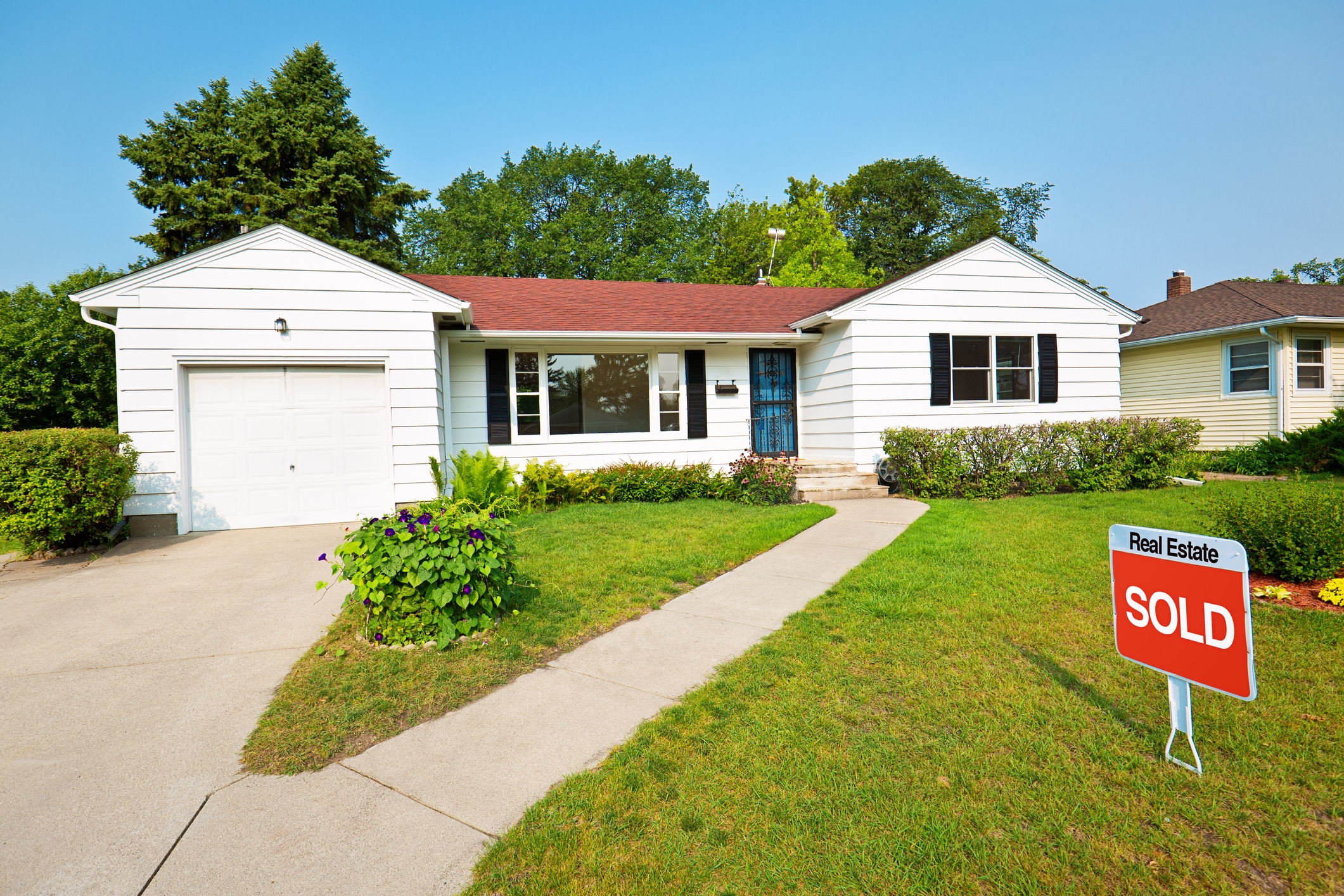

Sales of starter homes rose 3.9% year-over-year in June to the highest level in two years, according to a new report from Redfin. June was the 10th consecutive month in which home sales rose year-over-year. Pending sales of starter homes were also up last month with a 3.1% increase from one year earlier.
In comparison, sales of mid-priced homes (35th-65th percentile of the market by sale price) were down 0.9% year-over-year over the same period while high-price homes (65th-95th percentile) fell 3.6%. Pending sales of mid- and high-price homes fell 0.7% and 2.7% year over year in June, respectively.
The typical starter home sold for a record $260,000 last month, up 3.1% from June 2024. In comparison, prices of mid-price homes rose 2.1% to $370,784 from one year earlier, while high-price homes rose 2.7% to $577,177 – both were slightly below price records set in previous months. Redfin noted that although starter home prices were high, price growth has been slowing for six consecutive months and June’s pace was the slowest in a year.
“In a market where it’s difficult for most Americans to afford a dream home, many are turning toward starter homes,” said Redfin Senior Economist Sheharyar Bokhari. “They’re typically smaller and more modest, but starter homes remain within reach for some buyers who have been priced out of higher tiers. First-time buyers are especially apt to go for starter homes, as they don’t have equity from a previous home sale to help with their payments.”
















Idiotic. Unbelievable. There is a reason the number of sold homes is in the toilet. They are not cutting the rates. DROP THE PRICES
Home prices will continue to rise as the U.S. population continues to rise.
I do NOT know why people can NOT understand that concept.
The U.S. has 347 million people, which is 47 million MORE people than in 2006.
That means that in just 19 years,
the U.S. has ADDED the current population of California (39.4 million)
PLUS the current population of Arizona (7.6).
That’s an enormous number of people to ADD.
Projections are that the U.S. will rise to 380 million in the next 25 years,
which will mean ADDING another 33 million MORE people to our current 347 million.
Adding 33 million is equal to ADDING the current population of New York and Pennsylvania.
Thus, from 2006 too 2050 (a span of 44 years), the U.S. will have added 80 million more people (equal to ADDING current population of 4 States (California, Arizona, New York, and Pennsylvania).
Who thinks that home prices (or food prices) will fall as the population rises???
Many people have left the highest cost states to flee to lower cost states.
But those states then experienced a rapid increase in home prices as their populations rose.
States like Oregon, Washington, Arizona, Idaho, Florida, Nevada, Georgia, North Carolina, Texas, etc. have grown rapidly over the past 25 years, both from retiring seniors and from younger people seeking home prices that were affordable for the local wages.
But now home prices in those states are out of reach for new arrivals (or even existing residents).
Every time people flee to new lands, they repeat the same pattern by having too many children and inviting in too many people, too much population growth, etc., and the costs rise.
Many rural areas in the U.S. still have low prices, but they are not the best states for good paying jobs.
I hope that people reconsider how many children they have.
My Mom had 5 kids and tried for 8 kids. I witnessed that kind of high birth rate as being the main problem as I watched California get paved over with endless suburbs and disappearing open spaces. The same thing has been happening with expanding growth in other states, and people are now complaining about too much growth, too much traffic, and rising costs of living, and disappearing open spaces.
That’s what happens when the population is too high and continues to rise higher.
It’s a simple concept. We have been building more homes since the Europeans arrived.
We have built on flat lands, hilly lands, wetlands, steep slopes, even on bluffs adjacent to the ocean, and even in dangerous flood plains, just to try to squeeze in more housing for the growing population.
We have built high rise buildings to house more people. We’ve built smaller and smaller homes with little or NOT yard space to cram in more homes on less land, and, yet, we still do not have enough affordable housing because the population is too high in many areas but people keep insisting on having a growing population, as IF that were a good thing, when we all see that it is NOT.
Question your Indoctrination.
Never Ending Growth is the Mantra of the Cancer Cell.
If not stopped and reduced in size, it sickens or even kills its host body.
Human population has grown like a Cancer that is killing the biosphere and is killing our ability to live good quality, affordable lives.
The tension and fears from the impacts of Human population growth has led to another cycle of deep divisions in this country, but much of that can be traced back to hyper competition in an over populated world that cannot be blown up like a balloon to expand lands and waters and oceans.
It’s time to realize that the Human Population is the culprit in ALL environmental problems, in resource depletion, in rising costs of nearly everything, and is culprit in conflicts, wars, bigotries, mass human migrations, and abuses against humans and animals and nature.
Smell the Math. It don’t lie.
Cutting interest rates would help a little bit, but when interest rates go down, buying speeds up, and home prices rise faster. That is what happened since 2012 as interest rates dropped to historic lows, home prices rapidly shot up. Some slowing happened when rates when up rapidly to 7% (and are still close to that)
Really higher home prices now often offset any benefits from lower interest rates.
It’s still very expensive in many areas even if you could get a 3% interest rate.
What is weird is to see states like California insist on building affordable housing in some of the most expensive beach close areas or expanding home building into undeveloped areas that are far from job centers.
At a minimum, California should examine the many abandoned and high vacancy previously developed areas that are all over this state in most towns and cities, and are often located adjacent to downtown business districts, really great locations for housing and short commutes.
An example is the old manufacturing zones between downtown L.A. and South Pasadena. Those zones are huge and creepily empty, mostly abandoned manufacturing and run down commercial districts dating back to the 1930’s. Those mostly abandoned buildings would be prime areas to either convert the buildings to housing, or to tear them down (recycle components when possible), and build new homes on those previously developed areas.
South Pasadena has many retail shops that sit empty (as do most cities). There are commercia, office, and shopping centers (and malls) that are mostly vacant in many towns and cities, and some have sat empty for decades running. The zoning should be changed to housing or mixed housing & commercial because the owners of those lands are NOT using those lands as intended by the current under-lying zoning.
All those areas are well located and would be good locations for housing (remodels or new built). New York did those conversions to great effect; why can’t California do that?
Why expand ever outward into open space areas when better locations exist closer to work areas, locations that do not require damaging wild areas and do not require paving over open spaces and farm lands.
Some say that it is too expensive to convert commercial or manufacturing buildings to housing, or too expensive to tear them down. Well, that is short-sighted.
The State of California is the 4th largest economy in the world, a nation unto itself, economically speaking. it could start its own State Bank to give low interest loans for these types of beneficial projects. In the long run, funding redevelopment zones would save California’s last remaining open spaces and farm lands (which are some of the best in the nation), and it would keep development closer to job centers, and that means less commuter time, meaning less need to build or expand freeways and less transportation maintenance costs.
An infusion of affordable State loan funds for smart redevelopment is far better than long term, recurring road and freeway costs.
North Dakota started its own State Bank in 1919, and it has worked great for commerce, farming, and industry in that state by offering affordable loans.
California and many other states could easily do the same.
I would invest in a California State Bank. I think many millions of others would too.