


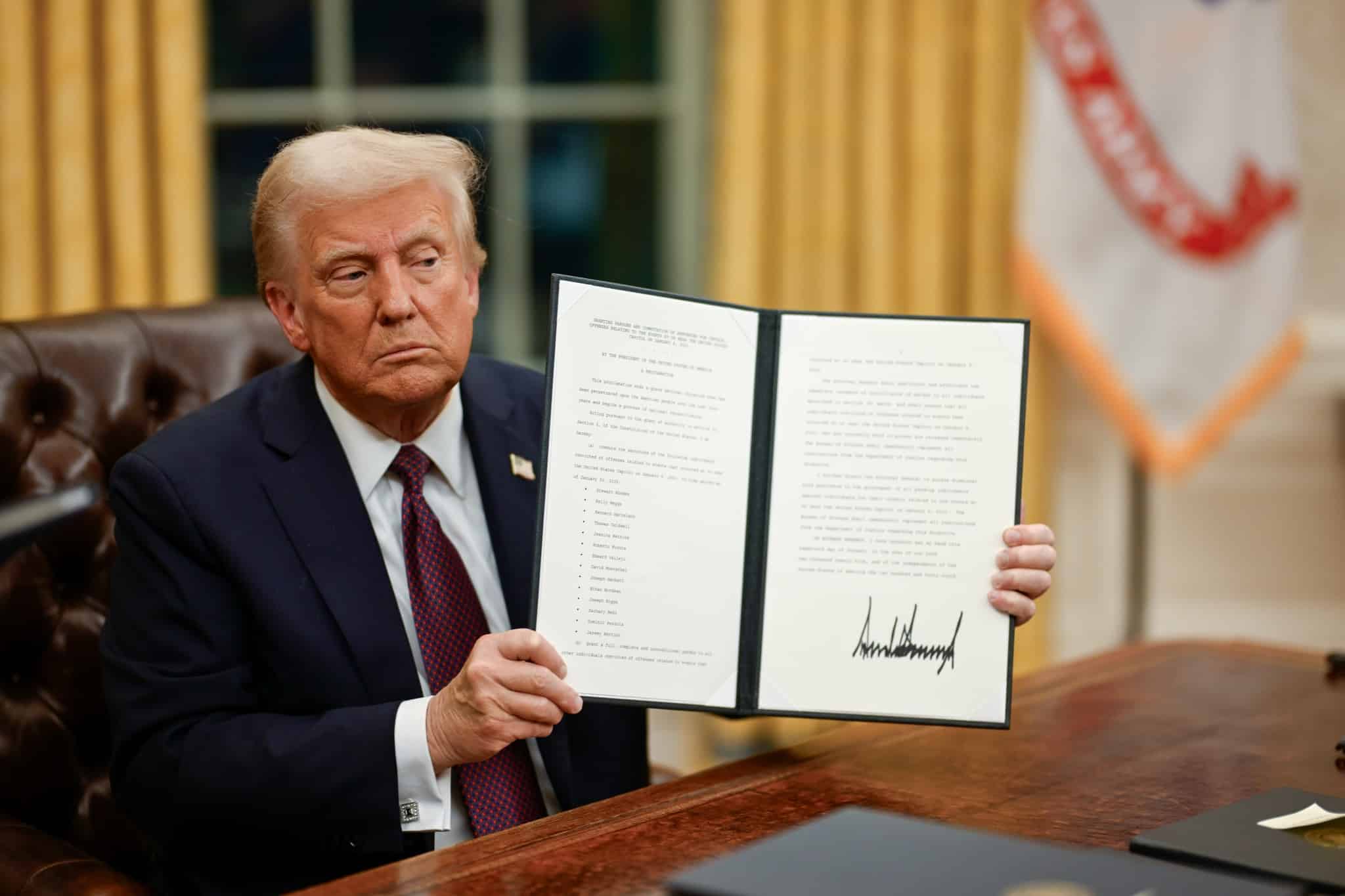
President Trump has announced that he will seek to ban institutional investors from acquiring single-family homes.
In a post on Truth Social, Trump declared, “For a very long time, buying and owning a home was considered the pinnacle of the American Dream. It was the reward for working hard, and doing the right thing, but now, because of the Record High Inflation caused by Joe Biden and the Democrats in Congress, that American Dream is increasingly out of reach for far too many people, especially younger Americans. It is for that reason, and much more, that I am immediately taking steps to ban large institutional investors from buying more single-family homes, and I will be calling on Congress to codify it.”
Trump added, “People live in homes, not corporations. I will discuss this topic, including further Housing and Affordability proposals, and more, at my speech in Davos in two weeks.”
This marks the first time that the president acknowledged the presence of institutional investors in the single-family housing market. However, Trump offered no details regarding the ban, nor is it clear why he is waiting for an appearance at the Swiss-based World Economic Forum.
In November, a report from the Lincoln Institute of Land Policy and the Center for Geospatial Solutions determined that corporate entities and investors now own 8.9% of residential parcels in 500 counties, or roughly one in 11 parcels. The report observed that corporate ownership exceeded 20% in some communities including St. Louis, Missouri; Harrisonburg, Virginia; and Franklin County, Ohio. The report defined corporate ownership as spanning the spectrum from smaller limited liability corporations to large institutional investors such as private equity firms, pension funds, and real estate investment trusts.
















Could be dramatic! There’s still a housing crisis, and maybe this would be posetive.
As a Realtor and occasional investor for 30 years who focuses on the lower end, I understand the principle. However, to make it illegal is a bad precedent. Who’s next? We usually handle these things with tax code. Unfortunately to change the tax code without any limitation on corporate size would ruin many small investors working hard on the American Dream. Perhaps a bracket system like we have for other parts of tax code? Also, eliminate the large corporate use of Opportunity Zone redevelopment, which was designed to benefit the big boys, and the tax credits for Section 8, which price out non-Section 8 low income renters. Oh, and my biggest frustration – rein in HUD and the state housing authorities, who have the grant system figured out. The percentage of doled out tax dollars that actually get down to people buying (and renting) the housing authority backed homes is deceptively small and the system is absolutely corrupt. So while the intention is good, the effort should be applied with more consideration.
we have been in this mess since the 1999 bill. We need the underwriting of foreign banks to cease. time to go back to the times previous to this bill from 1999. Foreign entities are taking over.
I don’t like how the government thinks they can control who does and does not
buy homes!! The only situation I dislike more was during Covid when small businesses had to close but not the giant corporations like Walmart, Sam’s Clib and Costco! Open markets all the way!! Lower the interest rates and whatever is wrong with the housing market!
the housing crisis is actually caused by this, the foreign banks, the purchasing of homes prior to foreclosure(s) by institutions such as this. time for we the people to be able to sell homes that need work to the people, the first time buyers, and buyers in general, to be able to repair them without 203k/renovation loans. To allow prospering!
This may chill some lenders. My recommendation would be that Lenders be required to perform a no minim bid auction of said assets one year from the date of a foreclosure. This gives ample time in most cases for a rehab and marketing.
Ron Kemper
40+ years Realtor/Broker/Receiver
no
I agree. Let’s see how this would work.
Makes perfect sense. Do it.
Amen
This is a good idea and will release inventory that is needed.
amen
This plan to allow investors to buy-up almost 65% of available housing inventory should have been stopped by Biden, but was not. Huge mistake being made right by Trump.
If there is no advantage to them buying in bulk, they’ll probably release a lot of single family housing to the open market again. Fingers crossed.
amen.
I agree that large institutional investors have bought a lot of the SFRs in the country. They like to show up at foreclosure sales and because they are working with other people’s money they are able to pay a much higher price that private investors. Sometimes they just leave the property vacant for long periods of time. I think we need to be carefuly not to throw the baby out with the bath water. I would hate to see all LLCs, Corporations, or Trusts banned from investing in SFRs. Many smaller investors use these entities to limit liability.
Too many people are not meant to be homeowners. They don’t want the responsibility of maintenance and repairs. They don’t keep up with their credit issues or taxes. They move frequently and/or just don’t want to be tied down. You will always have landlords and tenants. The best thing the government could do to intervein and fix the problem would be to better control the rental rates that homeowners should be allowed to charge for rent and force the homeowners to maintain the properties to a reasonable minimum living standard. Too many slumlords sitting around getting rich off other people’s discomfort and while creating high crime areas and slums.
I believe the market should control rental prices. Some landlords barely break even. I have read that Blackrock is buying up large plots of land, including farmland and cattle farms, then putting in large residential developments for sale and rent. China is also buying up farmland. I agree with stopping these kind of purchases. That said, the new thing around here is developers building an entire subdivision for rental purposes. This is a good thing because tenants who rent from homeowners always have the risk of having to move out because the owner wants to sell and this offers a safer alternative.Also, there are no standards of safety. My grandson rented a house where the owner had the septic emptying under the house. There was mold all over the walls and the A/C wasn’t working. There are no inspections for rentals……plus they were paying market rent. I would like to see required inspections for rentals, or at least allow an option for the prospective tenant to do one. If a management company has the rentals, a Security deposit plus first and last months rent and their credit has to be good. The rentals are shown to several people at once, so the prospective tenant who wins gets the rental….they may as well buy. Slumlords take advantage of desperate people with low income and credit score.
no, jimmy. no! if the rent is rent controlled, then the owners will lose the homes to tax increases. Not everyone should own a home, however, that is NOT the issue.
I live in the western suburbs of Chicago. Been a realtor for over 40 years. I see the investor conglomerates come and buy large tracks of new housing in particular. They effecting both the buyer and rental markets. House pricing is going up with large number of purchases by the investors often eliminating the affordable houses. In the rental market they have take over so much there is little to find outside of this group and escalated rental prices. I agree with Trump. Many buyer feel that they can’t afford, terr is nothing ot Teresa I can afford and I can’t save up enough. Trump could make their dream within probability.
thank you dolly!
Interesting. I work with several LLC’s that buy distressed homes under there LLC for liability purposes, and then fix them up for rentals, or sell them. I do the same once or twice a year. So this is bad?? It really helps by taking a dump of a house, often vacant, abandoned, and making it livable
You also can help make a less desirable neighborhood more desirable by doing this.
Sure, and you do as little as you have to, as cheap as possible to make the property habitable. Then throw it into the rental market for the maximum and sit back and get rich while the little people suffer because you stole even an opportunity away from them with the power of cash.
no. the full story is that the regular buyer cannot buy a house that needs work. why? underwriting. so they move to get a 203k / renovation loan and that is either too complicated OR if the buyer is a contractor they cannot hire themselves to do the work. This boxes out buyers. Also, to buy a home that needs work and have to finance the money to repair it all at once is then not affordable. This issue arose from the “non repairing” of the crash that has never been repaired… This is a foreign underwriting issue. I stand for the people.
I agree with limiting the large corporations from buying in this market but I am a small LLC in the rental market and this is where I make a living. Just because I have an LLC should not stop me from buying a house. There has to be a better way to determine the limit.
Awesome, this is what I’ve been saying needed to happen for a long time! We should celebrate this for our kid’s future! 🥳
yahoo! God hear our prayers!
I believe it is too late to put that toothpaste back into the tube. There is also the question of negative affect on homeowners that would have a reduced buyer pool. Additionally, how does one define an institutional buyer? Today’s local or regional investors can grow to “institutional” pretty quickly. Where, I believe, there is a solution would be an open marketplace for bank owned or at risk residential assets. From 2008-12 there was a “perfect storm” environment where there was amnesty from phantom income for a short sale. This encouraged some buyers to move up ( before credit issues) and then essentially walk away from the short sale trailing home. Here the now government controlled loans seldom made it to the market. This practice should be prohibited. The concept of auctions and delayed purchase window doesn’t solve the problem of a finance dependent buyer ( mortgage contingency) competing with an “as is” cash buyer. Additional solutions could include a crackdown on predatory purchases ( many of the “we buy your house for cash and no fees”). Clearly, many of these buyers are taking advantage of an aging population of sellers and flipping these homes at excessive profit margins. Like many license laws where a licensee purchases for investment and is required to disclose, there is also legal liability for excessive gains if the sellers were not properly informed. Here a licensee has a higher standard than a “public person”. Here is where investors of a certain size are classified similarly to how a licensed Broker/salesman is classified. Defining and designated “sheep and wolves”. There is a problem and broad brush stroke solutions are not the answer. There are small steps that in aggregate may help entry level resale supply recovery.
I need to start working on that homeowners insurance rate problem.
How about having these big companies and their shareholders have to prove that they need to have the rates go up? How about people who don’t have any claims don’t have to pay an increase in their insurance rate. How about caps on insurance rates.
say you can’t; then you can’t. God can do anything and we must try!
Well about time I have been preaching this for a number of years. It is never too late to correct something that has had a negative effect on housing, causing many to look at the prosepect of lifetime renters, which is OK if that is their choice. The next move is to make the institutional owners of single family homes divest over a period of time so as not to cause a crash in values for anyone. maybe a period of 10 to 15 years. This gradual influx of available homes will improve the quality of life for many Americans without causing finacial loss on anyone. There are plenty of investment opportunities for those who want to invest. Love the rental market, then build quality rental complexs with the profits from the single family sales and still have the rental income the investor needs to justify their porfolio.
nice! me too!
We all know that an affordable housing crisis is worsening. The American dream of homeownership is becoming a nightmare. Generational wealth is being stripped from the transfer of assets to the next generation. When rental housing becomes the only available housing option for those entering the housing and shelter market, we rob our children of a prosperous future through homeownership.
A few things…
I can almost guarantee that nearly every Realtor organization, in almost every area (red, blue or purple) will fight this on principle. That principle being that property ownership is a private transaction that should remain as ‘unfettered’ as possible. As somebody serving on a Government Affairs Committee (both state and local) for most of my decades-long career, I can tell you, that is a constant fight we have locally, state-wide and regionally, and I’m certain NAR is lobbying somebody about it right now as I type. I’m not saying this is even a good or bad policy, merely stating that both the proposal as it (very loosely) stands and those cheering from the comment section should recognize, in general, any level of government getting (more) involved with commerce and property ownership is typically anathema to Realtors.
Having said that…
There is a certain level of hypocritical irony in the comments. As somebody that has probably been to more county and state-level GOP meetings than most people here have even voted alone, it is hilarious that all of sudden the MAWA people are all for MORE government regulation, especially in the realm of real estate. A field more concerned typically with getting rid of regulations is suddenly super invested in taking rights away from people. Keeping in mind, the GOP is the party that supported Citizens United, which made the same corporations now being whined about the equivalent of ‘people’. So they are going to whine/lobby even harder now to make sure they keep their ability to keep buying everything they can. (Further irony that the dude that once tried to have an elderly women ’eminent domained’ out of her home so he could build a parking lot for a casino he would eventually bankrupt is now trying to pretend he ‘cares’ about ordinary folks. People will just believe anything, I guess.)
Lastly…all the rah-rah that your orange messiah is doing this instead of Biden (who mostly did not even know which day of the week it was) would have been SCREAMING “this is COMMUNISM!” if he had done the same thing. “The government can’t tell businesses what to do!” The whole whiny gamut.
Unless they very narrowly restrict how this works (almost to the point of it being pointless), there will be lawsuits galore to stop it, and those REITs all have VERY deep pockets.
Good luck.
@Dave Weinert
Very good points, the best commentary so far.
Absolutely agree with those points. Also people are completely forgetting the issues of taxes, Insurance, over regulation on housing and poor monetary policy hyped up with inflation on top of that, just to name a few. The Corporate ownership is tiny compared across the US as a whole. Do I like, no I don’t. But this plan will not resolve anything if you don’t deal with the other issues which our gov, never will. This is more of a virtue signalling move. No large corporation is sweating this.
that is too bad. NAR has not been in the correct position for at least a decade and a half. in massachusetts they have been pushing for corporate overbuilding which sits on the tax payers backs and pushes more properties in to LLC property ownership. Massachusetts now has “the millionaires tax” which is a 4% tax on all sales $1,000,000 plus no matter what is owed. The lending industry was defiled and then “repaired” but not repaired but hindered by Bank of America, a lie at its name, and their purchase of countrywide and their buy out from We The People and Gm to GMAC… the whole thing was a coo. We the People were sold a game of Monopoly by HGTV and the like. Home ownership was hijacked. Then, The Lawsuit was a horrible joke that put We the Realtors all in a guilty position which I for one know many are not guilty, just a few. This should have been fought; no one should be guilty for others actions. The ones who were in dual agency default; they should have been tried; again NOT all of us. The way NAR is now is on the corporate side/soros/globalists. The way it is going we will not own houses with the help of this unhinged leadership(NAR) of the former largest protector of property ownership.
The difficulty with institutions buying blocks of 100+ single-family homes causes a reduction in the availability to homeowners. The second problem which has been in greater Phoenix area as they then will rent them out with no qualifications, and they end up actually having gang banging neighborhoods of danger to the residents. With an influx of approximately 20 million illegals taken available housing institutions buying the housing. It is an unfair action hurting actual homebuyers!
amen.
I’m glad Trump is addressing the issue. As foreclosures go up again the investors are able pay cash and are able to snap up large blocks of properties at auction at discount without anyone else even given a chance. I’ve seen this happen. How it will be worked out is going to be tricky. Home ownership was last promoted with OBama. I was hoping this president, a real estate guy, would do something. We’ll see!
Awesome idea. General public’s life became hell finding a decent place to live.
this is a great idea..love Trump… first president in many many many years to think outside the box. thank you Donald
The same leftists funded by the likes of Blackrock are going to hate this. They like Blackrock buying tens of thousands of homes so they can complain about “affordable housing” and expand the government. The left creates crises to solve them with more corrupt government.
amen!!!!!!!!!!!!!!!!!!!!!!!!!!!!!!!!!!
John,
I read your piece carefully, and I disagree with its premise almost entirely. This issue deserves more than careful phrasing around an uncomfortable truth.
Your article frames institutional investor dominance in single-family housing as a secondary effect of a broader supply failure, unfortunate, uneven, but ultimately misdirected as a policy target. That framing is not nuance. It is deflection.
Yes, the country underbuilt housing for years. Yes, zoning, permitting, and construction costs remain broken. Those truths are well-established. But they do not excuse, or minimize, the consequences of allowing large, well-capitalized institutions to systematically outbid families for entry-level homes during a historic affordability crisis.
You ask why this became an issue “in the first place,” then answer without assigning responsibility to those actively exploiting the imbalance. Institutional investors did not merely “magnify” damage in certain markets; they materially altered outcomes. In many ZIP codes, they reset prices, displaced owner-occupants, and converted pathways to home-ownership into permanent rental funnels.
The repeated reliance on national averages misses the point entirely. Housing is local. A 15–25% investor’s share in targeted neighborhoods is not a footnote; it is determinative. Families do not buy homes in national data sets; they compete in specific markets where scale, cash, and patience overwhelm wage-based buyers every day.
Your assertion that “banning buyers does not create homes” is accurate, and beside the point. Not every policy exists to increase supply. Some exist to prevent further harm while structural reforms catch up. We regulate behavior in markets all the time when outcomes become destructive. Housing should not be the lone exception.
The suggestion that capital will simply reroute if restricted is not an argument against action; it is an admission that this capital is opportunistic rather than essential. Redirecting institutional money toward multifamily development, purpose-built rentals, or actual construction is not symbolic politics. It is appropriate market boundary-setting.
Most concerning is the article’s implication that drawing such boundaries is performative while preserving the status quo is pragmatic. Public trust in the housing system is eroding precisely because people see who is winning and who is locked out and they are no longer persuaded by abstractions about supply curves while families lose bidding wars to funds.
Homes are not interchangeable commodities. They are the foundation of household stability, wealth formation, and community continuity. When the system prioritizes yield over residency, it should not surprise anyone when policymakers respond.
This is not anti-market. It is pro-function. If the real estate industry wants credibility in this conversation, it must stop minimizing the role of institutional concentration in single-family housing and stop treating corrective policy as naïve. The public understands the outcomes clearly, even when commentary attempts to soften them.
Respectfully,
Mark Richardson – Realtor Columbus, Ohio
NOPE, disagree almost completely. This is all created by the bill in 1999. The design to take over through allowance of all funding to then taking away funding. The only funding that should have been stopped to repair it is NO document loans that made people fail. The failure is owned by corporations. Foreign banks / underwriting is now preventing home ownership. This was a plan. Our zoning is fine without overlays that allow for corporate building that weighs on the infrastructure to create failure. example: Los Angelos. a complete disaster. when it burned due to the lack of water that the leaders ignored and now the permits are not being given. Let’s talk about 15 minutes cities and the Hawaii incident. and a local favorite of mine. allowing over 300 condos in the 80s in a small town that caused crisis on schools in the town. It happened all over in mass (probably other areas as well) putting in subdivision control that made planning boards need to consider what building would do to infrastructure such as: roads, schools, police, fire, water supply and the like. Time to understand that overlays create issues with infrastructure that corporate developers walk away from with as of right building beyond the zoning by laws of towns. It is common sense. The other thing that should be looked into is the globalist and L.A. mayor written books that are behind the zoning by law changes… By laws are not passe they are written with experience in the needs and safety of a community. Allowing changes that are written by globalists is a modern-day land steal. Wake up! before they own you. Have you ever heard of the Trojan horse?
Goooooood. Now drop the prices
Key words are “in two weeks.”
Two weeks never seems to bring more than a concept of a plan.