


Source: The Washington Post —
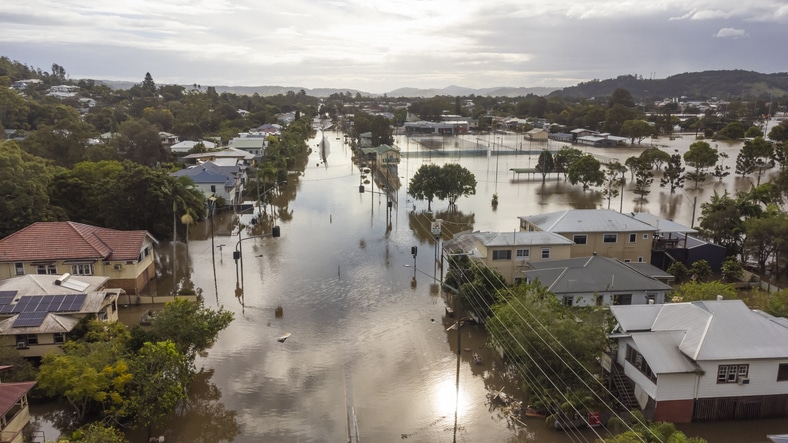
The combination of federal flood maps that don’t reflect the true scope of risk in a warming world, government insurance policies that subsidize development in flood-prone areas and buyers who haven’t accepted the dangers posed by climate change all contribute to the prospect of a future real estate bubble, researchers found.
They estimate that across the United States, properties in vulnerable areas are overvalued by $121 billion to $237 billion, and that if those unacknowledged risks are realized, low-income homeowners in particular stand to lose significant amounts of equity.
“As we’ve seen in California the last few weeks, these aren’t hypotheticals, and the risk is more extensive than expected — and that risks carries an enormous cost,” said Jesse Gourevitch, a lead author of the study.
But individual homeowners won’t be the only ones facing the financial fallout.
Thursday’s study, which includes researchers from the Environmental Defense Fund, Resources for the Future and the Federal Reserve, also details how municipal governments that rely heavily on property taxes could face huge budget shortfalls as flood-prone homes lose value or become uninhabitable.
“It could mean less revenue for infrastructure, for schools, for social services,” Porter said. “It actually impacts the entire community.”
According to the study, a significant portion of overvalued properties are concentrated in communities along the Atlantic and Gulf coasts that have heightened exposure to hurricanes and rising seas, lax flood-disclosure laws and a high proportion of residents who do not view climate change as an imminent threat. Properties in Florida are overvalued by $50 billion based on their actual flood exposure, according to the researchers’ calculations.














0 Comments