


Summary
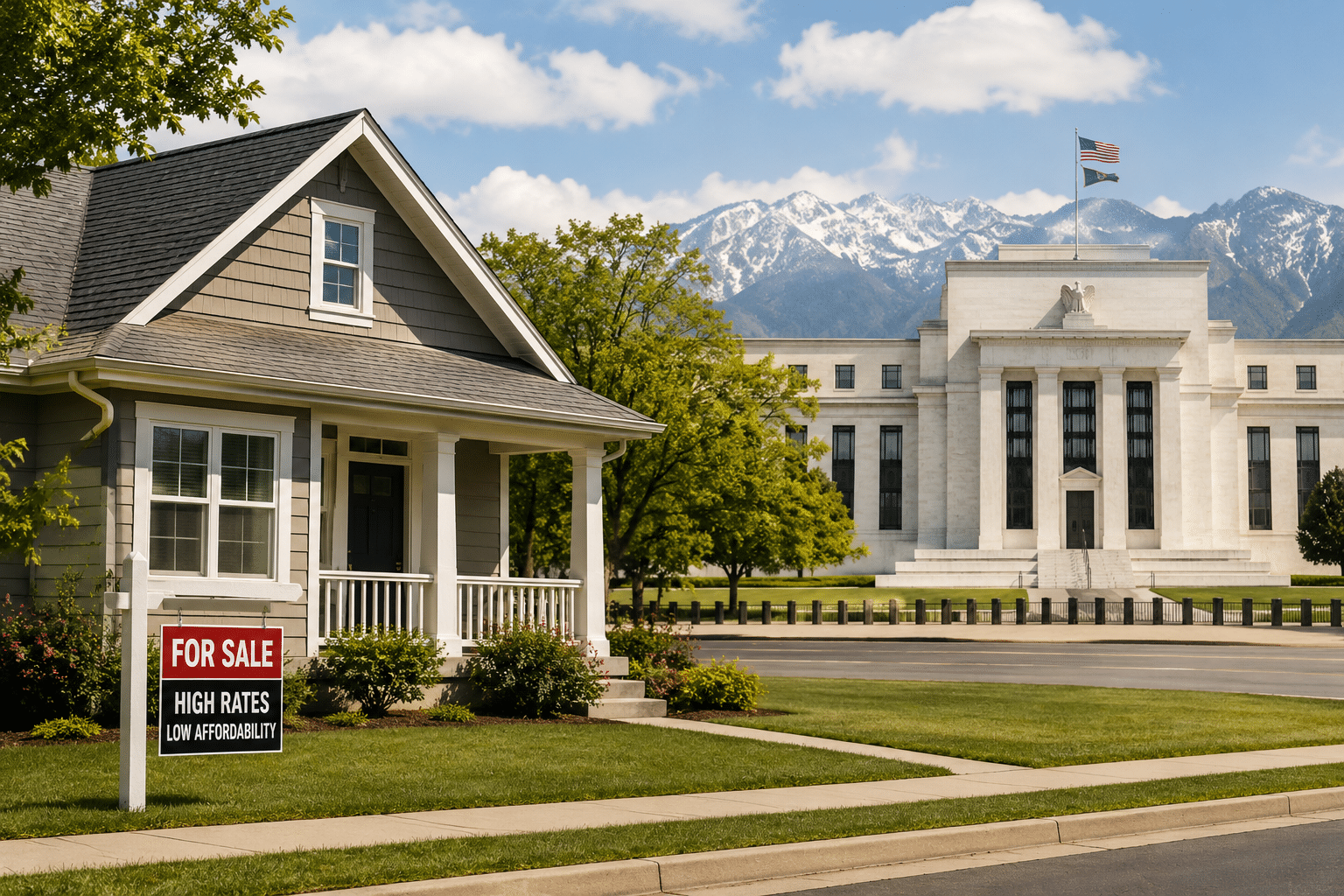
Federal Reserve Chairman Kevin Warsh acknowledged that housing is showing strain but said inflation should remain the Fed’s predominant focus. His Jackson Hole remarks suggest housing weakness alone is unlikely to push the central bank toward easier monetary policy.
Federal Reserve Chairman Kevin Warsh delivered a difficult message for the housing industry Friday: The Fed sees the strain in housing, but that weakness is not enough to shift its attention away from inflation.
Speaking at the Federal Reserve Bank of Kansas City’s annual economic policy symposium in Jackson Hole, Wyoming, Warsh described an economy that has remained resilient despite pressure in parts of the country. Business investment is growing, labor markets remain stable, credit is readily available and consumer spending has held up.
Housing is one of the exceptions.
“Certain sectors—like housing and agriculture—are showing strains,” Warsh said. But when he looks across the economy as a whole, he added, broad financial conditions are difficult to characterize as restrictive.
For an industry that has spent years waiting for borrowing costs to provide meaningful relief, that distinction matters.
The average 30-year fixed mortgage stood at 6.66% this week, according to Freddie Mac, compared with 6.65% a week earlier and 6.56% one year ago. Mortgage rates do not move directly with the federal funds rate, but expectations about inflation, Federal Reserve policy and the direction of longer-term Treasury yields are important parts of the environment in which mortgage rates are priced.
Warsh gave markets little reason Friday to assume that the Fed is prepared to prioritize lower borrowing costs simply because housing is struggling.
Instead, he repeatedly returned to inflation.
The Fed’s preferred inflation gauge, the Personal Consumption Expenditures price index, was 3.7% higher in July than a year earlier, according to the Bureau of Economic Analysis. Core PCE, which excludes food and energy, increased 3.3% over the same period.
Both remain well above the Fed’s target.
Warsh made clear that he does not view 2% inflation as an aspiration that can be adjusted when economic conditions become uncomfortable. He called it a “firm, fixed target” and said responsibility for achieving price stability belongs to the central bank.
Later in the speech, his assessment became even more explicit.
“The Fed’s predominant focus right now should be on prices,” Warsh said.
Housing is weak. The broader economy isn’t.
That may be the most important takeaway from Jackson Hole for mortgage and real estate professionals.
Housing affordability has been squeezed by a combination of elevated home prices and mortgage rates that remain well above the levels borrowers became accustomed to during the years before and immediately following the pandemic. Yet monetary policy is set for the national economy, not for one industry.
Warsh pointed to several areas that he believes demonstrate underlying economic strength.
Business investment in equipment and intangible assets has grown roughly 9% over the past four quarters, according to the figures he cited. Corporate credit spreads remain near the low end of their historical ranges, issuance in corporate bond and leveraged-loan markets has been strong, and bank lending standards for commercial and industrial loans are relatively easy by historical standards.
“Credit and loan markets are showing few signs of policy restraint,” he said.
The labor market also does not appear to be giving the Fed an urgent reason to ease policy. Warsh said the 4.1% unemployment rate remains low historically and described current labor-market conditions as consistent with full employment.
Put those pieces together and the Fed faces an unusual split.
Housing can be under considerable pressure without the economy as a whole behaving as though monetary conditions are especially tight.
That makes the path toward substantially cheaper mortgage financing more complicated.
Warsh isn’t promising the next move
There is another important change underway at the Fed that markets will have to get used to.
Warsh is openly skeptical of the central bank’s longstanding reliance on forward guidance — the practice of signaling how policymakers expect interest rates to evolve before those decisions are actually made.
He argued Friday that excessive guidance can cause markets to rely too heavily on the Fed’s projections and can also constrain policymakers when economic conditions change.
In normal economic conditions, Warsh said, forward guidance should play a much smaller role.
That means mortgage professionals, investors and consumers looking for an explicit signal about the next rate decision may not get one.
Warsh did not promise a rate increase Friday. He did not promise a rate cut. He did not commit the Federal Open Market Committee to a predetermined path at all.
“I stand here today committed to a discipline, not to a decision,” he said.
His standard for inflation, however, was considerably clearer. Warsh said policymakers need to become confident that underlying inflation is moving toward the Fed’s objective clearly and quickly enough. If it is not, he said, the Fed still has work to do.
What this means for housing
For housing, Jackson Hole did not deliver the relief signal many in the industry would welcome.
It delivered something more useful: a clearer explanation of the hurdle that must be crossed before monetary policy becomes materially more supportive.
Housing weakness by itself does not appear to be that hurdle.
The Fed is looking at an economy in which unemployment remains relatively low, consumers continue spending, businesses are investing and credit remains available. Against that backdrop, inflation running substantially above 2% becomes harder for policymakers to overlook simply because home sales, mortgage originations or housing affordability are suffering.
That does not mean mortgage rates cannot decline. Mortgage rates are determined in capital markets and can move in anticipation of changing inflation, economic growth, Treasury yields and future Fed policy well before the central bank changes its benchmark rate.
It does mean the housing industry should be careful about building its expectations around an assumption that the Fed will soon provide the catalyst.
Warsh acknowledged Friday that housing is strained.
He also made clear what has the Fed’s attention now.
Inflation.
















0 Comments