 Weekly Real Estate News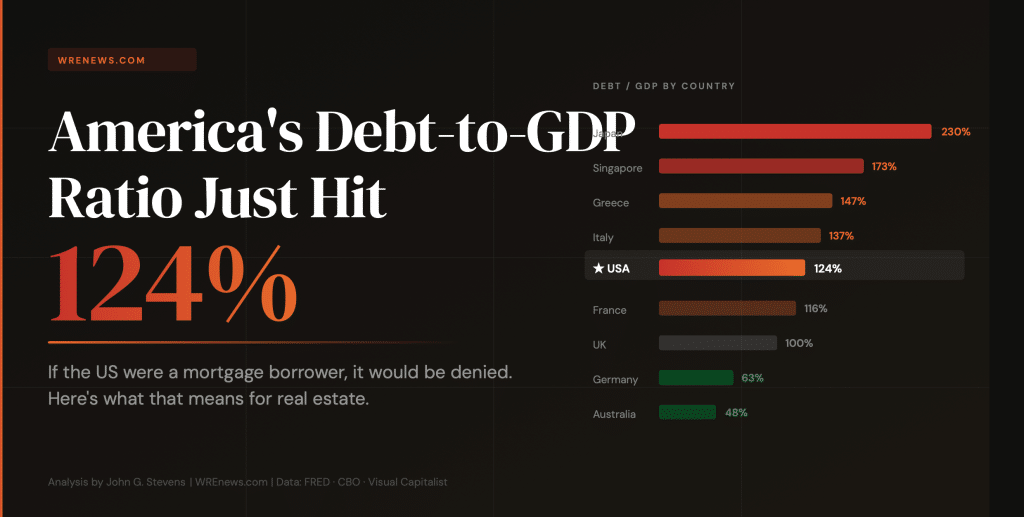
I was sitting in a meeting recently listening to a market update from one of the sharpest financial minds I know — Aaron VanTrojen, a CEO with his finger on the pulse of the mortgage industry. He dropped a number that stopped the room.
America’s debt-to-GDP ratio hit 125% in 2025.
Let that land for a second.
If the United States of America walked into a mortgage office and handed over a loan application, any trained underwriter in the country would stamp it DENIED before the ink dried.






What Is Debt-to-GDP — and Why Should Real Estate People Care?
Debt-to-GDP is the closest macro equivalent to the DTI ratio we use every day. It measures what a country owes relative to what it produces — its economic output. It’s the nation’s income versus its debt load.
The Federal Reserve’s own data confirms the number: ~124–125% of GDP as of December 2025, per FRED and CEIC. The total national debt has crossed $39 trillion. And it’s growing by roughly $1 trillion every 90 days.
If this were a borrower file on your desk, here’s what the 1003 would look like:
- Annual “income” (tax revenue): $5.2 trillion
- Total debt: $39 trillion
- DTI: 124% — and climbing
- Monthly debt service (interest alone): ~$79 billion/month
- Credit rating: Just downgraded by Moody’s in May 2025 — first time since 1917
You wouldn’t just deny that file. You’d call your compliance officer.
How Did We Get Here?
This didn’t happen overnight. America has been down this road before — and actually found its way out. Here’s the honest history:
The US has carried debt since the Revolutionary War. Our debt has always spiked during wars and crises, then (historically) come back down. After World War II, our debt-to-GDP hit 112% — nearly what it is today. But by 1974, it had fallen all the way to 23% — not because we paid it down, but because the economy grew so fast that the debt became small relative to output.
Then the drift began. The Reagan deficits, the 2008 financial crisis, and COVID-19 each ratcheted the number higher without the growth rebound to follow. The pandemic peak hit 130% in early 2021. We bounced to 112% by 2022, and now we’re climbing again — faster than before.
The Congressional Budget Office projects debt could reach 134% of GDP by 2035 if nothing changes.
How Does America Stack Up Globally?
Here’s where it gets uncomfortable. We’re not the worst — but we’re in bad company:
| Country | Debt/GDP |
|---|---|
| Japan | ~230% |
| Singapore | ~173% |
| Greece | ~147% |
| Italy | ~137% |
| United States | ~124% |
| France | ~116% |
| UK | ~100% |
| Germany | ~63% |
| Australia | ~48% |
The EU actually has a rule — the Stability and Growth Pact — that member countries should keep debt below 60% of GDP. We’re running more than double that.
Japan is the cautionary tale most economists point to. They’ve been at 200%+ for years without collapsing — but their debt is held almost entirely by domestic investors and their own central bank. It’s a closed loop. The US is different: $8.5 trillion of our debt is held by foreign governments and investors. That dependency is the vulnerability that keeps bond traders up at night.
Could You Even Lend to the US If You Wanted To?
Here’s the strange part — and it’s worth understanding if you work in this industry.
The United States isn’t like a regular borrower. There’s no court that can foreclose on the Capitol. There’s no servicer that can call the note. The US controls its own currency, which means it can print money to service debt in ways no individual borrower ever could.
But that doesn’t mean there are no consequences.
When the US government needs to borrow at this scale, it issues Treasury bonds — and those bonds compete directly with mortgage-backed securities for investor dollars. When the government is a massive borrower, it crowds out private lending and pushes rates higher. That’s not theory. That’s what you’re seeing in the mortgage market right now.
The $952 billion the US paid in net interest in FY2025 — nearly $1 trillion, just in interest — is money that isn’t building roads, funding schools, or creating the conditions for housing supply to expand.
And when Moody’s downgraded America’s credit rating for the first time in over 100 years? That’s the market sending a message. The world noticed.
WREnews Market Intelligence
America's Debt-to-GDP: The Loan File That Would Get Denied
If the US were a mortgage borrower, no underwriter would approve the file. Here's what the data actually shows — and what it means for real estate.
Debt / GDP ratio
~124%
FRED / CEIC, Dec 2025
Total national debt
$39T+
March 2026
Annual interest cost
$952B
FY2025 net interest
Moody's rating
Aa1
Downgraded May 2025
US Debt as % of GDP — Historical Timeline
Historic low: 23% in 1974. Post-COVID peak: 130% in 2020. Today: ~124% and climbing. Source: FRED / U.S. Office of Management and Budget.
Global Comparison — Debt as % of GDP (2025)
The Mortgage Underwriter's Verdict
Would you lend? — Conditional Deny
A 124% DTI would auto-deny any retail borrower. No lender approves when liabilities exceed annual income by 24 points. Debt-service alone consumes 15% of all federal spending — nearly $1 trillion/year in interest.
Could you even lend? — Legally Complicated
The US controls its own currency — no conventional foreclosure exists. But when Moody's downgrades and foreign creditors hold $8.5T of your debt, confidence itself becomes the collateral.
Four Paths to Fixing It
Grow out of it
Post-WWII went from 112% to 23% in 30 years — not by paying down debt, but through sustained GDP growth outpacing borrowing.
Cut structural spending
70% of the budget is mandatory. Real reform requires entitlement conversations nobody in Washington wants to have.
Broaden revenue base
US collects ~17% of GDP in taxes vs. 24–30% in peer nations. Closing loopholes could close ~$500B/yr of the gap.
AI productivity surge
If AI drives 3–4% GDP growth annually, the debt ratio shrinks organically — faster than any policy change alone.
Data: Federal Reserve (FRED) · CEIC · Congressional Budget Office · Pew Research · Visual Capitalist
Analysis by John G. Stevens | WREnews.com
So How Do We Fix It?
I’m solution-driven. Always have been. And here’s the honest answer: there is no single lever. But there is a playbook.
Path 1: Grow out of it — This is how we did it after WWII. We didn’t pay down the debt. We grew so fast that the debt became a smaller percentage of a much bigger economy. If America can sustain 3–4% GDP growth — especially with AI-driven productivity gains — the ratio naturally shrinks. This is the optimistic scenario, and it’s not impossible.
Path 2: Cut structural spending — 70% of the federal budget is mandatory: Social Security, Medicare, defense. Trimming around the edges won’t move the needle. Real fiscal discipline requires the political courage to reform entitlements — the kind of conversation nobody in Washington wants to have but everybody knows has to happen.
Path 3: Broaden the revenue base — The US collects about 17% of GDP in taxes, compared to 24–30% in peer nations. That gap isn’t necessarily an argument for higher rates — it’s an argument for closing loopholes, expanding the base, and making the system less riddled with carve-outs.
Path 4: The AI wildcard — If artificial intelligence delivers even a fraction of the productivity revolution it promises, we could see economic growth rates not seen since the postwar boom. That’s the scenario where we grow our way out faster than anyone expects. It’s speculative — but it’s on the table.
The worst outcome isn’t the debt itself. The worst outcome is paralysis. Pretending the number isn’t real. Kicking the can until the can explodes.
Why Real Estate Professionals Should Be Paying Attention
I know what you’re thinking — what does federal debt have to do with my listings?
Everything.
High government borrowing = persistent upward pressure on interest rates. Persistent rate pressure = suppressed affordability. Suppressed affordability = frozen inventory. Frozen inventory = the market we’ve been navigating for two years.
The path back to a healthy housing market runs directly through fiscal health. Not partisan politics — math.
The good news? America has solved bigger problems than this. We came out of a world war with debt higher than today, and 30 years later we were at 23%. The engine of this economy — when it’s running — is unlike anything the world has ever seen.
But first, we have to be honest about where we are.
A 124% debt-to-GDP ratio isn’t a political talking point. It’s a loan file. And right now, the file needs work.
John G. Stevens is the founder of WREnews.com, a daily real estate news publication reaching tens of thousands of real estate and mortgage professionals across the country. Data sourced from the Federal Reserve Bank of St. Louis (FRED), CEIC Data, Congressional Budget Office, Pew Research Center, and Visual Capitalist.




Great analysis. An underlying difficulty is that, even had we not just had more tax cuts implemented, we are just not collecting taxes from those who have benefitted most from the infrastructure and opportunities the U.S. provides. I’m not someone who hates the rich, but I do hate to see how little our country benefits from offering a “safe space” for the ultra-wealthy. Check out the Ezra Klein podcast with law professor Ray Madoff “Our Tax System Should Make You Furious.” https://www.youtube.com/watch?v=mX5U5DNUfBc