 Weekly Real Estate News

Summary
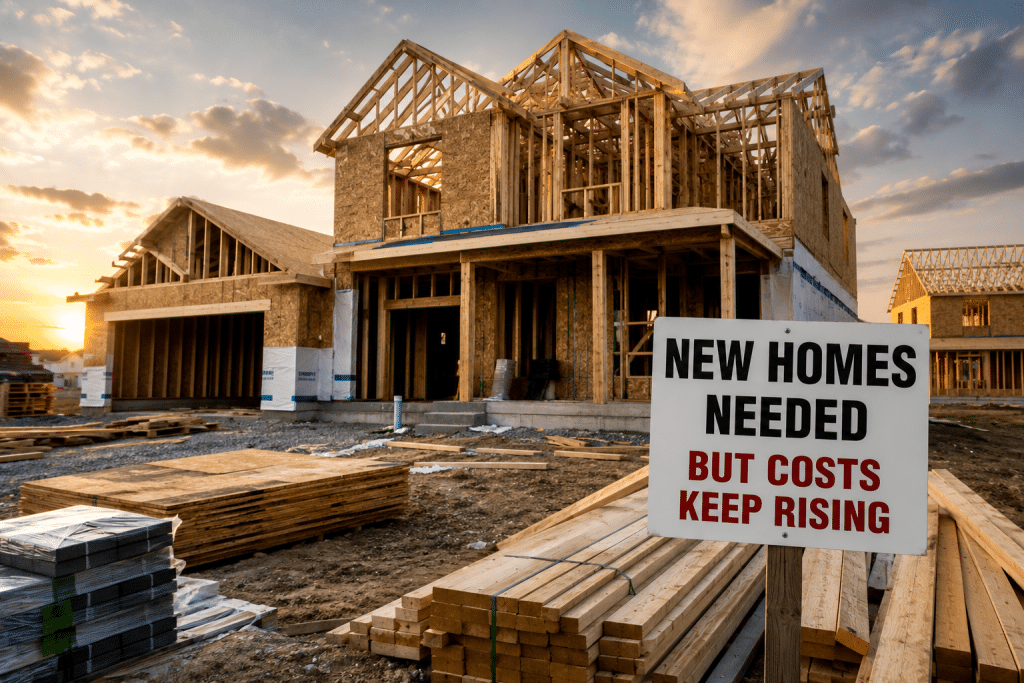
America needs more housing, but producing it is becoming increasingly difficult. Builders are facing higher material and development costs while buyers are already struggling with affordability. John G. Stevens examines why solving America's housing shortage requires more than simply telling builders to build—and why housing supply and housing affordability must be addressed as the same problem.
For several years now, nearly every serious discussion about housing affordability has eventually arrived at the same conclusion: America needs more homes. I don’t disagree with that conclusion. What bothers me is how often we stop the conversation there, as though identifying a shortage tells us how to economically produce the homes needed to solve it.
It doesn’t.
Builders still have to buy land, develop lots, pay for materials and labor, finance construction, navigate permitting and regulatory requirements, and carry the risk of a project until the homes are sold. At the end of that process, they need a buyer who can afford what they built. That last part has become increasingly difficult, and it is one reason I think we need to change the way we talk about housing supply.
Removing unnecessary zoning and permitting barriers absolutely matters. There are places in this country where it takes too long and costs too much just to get permission to build. But approving more housing and actually producing affordable housing are two different things. If the economics do not work once the permit is issued, the permit isn’t going to build the house.
The latest construction data gives us a good reason to have that conversation now.
Construction is showing some warning signs
The Census Bureau reported that overall housing starts fell 12.4% in July to a seasonally adjusted annual rate of approximately 1.24 million units. Single-family starts came in at an annualized 808,000 units, 9.9% below the revised June estimate.
There is an important qualification to that monthly number. Census reported a margin of error of plus or minus 10.4% around the estimated 9.9% decline in single-family starts, so we should not pretend one month of data proves something that it doesn’t. The estimated year-over-year decline is more substantial: single-family starts were 15.7% below July 2025.
Permits moved differently. Overall permits increased 5% from June, while single-family permits rose 2.5% to an annualized 894,000.
I find that difference worth watching. Builders were still obtaining authorization for additional homes, but actual starts were running at a considerably weaker pace. We will need more than one month’s data to know how persistent that gap becomes, and anyone who has followed housing data for very long knows how much these numbers can move from month to month. Still, it is difficult to look at the construction data without also looking at what builders are telling us about the market they are operating in.
The National Association of Home Builders/Wells Fargo Housing Market Index registered 35 in August. A reading above 50 indicates that more builders view sales conditions as good than poor, so 35 is not exactly a picture of confidence.
What interests me more is what builders are doing about it.
NAHB reported that 35% of builders cut prices in August, with an average reduction of 6%, while 63% used some type of sales incentive. Those figures tell us quite a bit about the leverage builders currently have with consumers. A company that believes buyers will readily absorb another increase in the price of a home generally doesn’t need to cut that price or spend additional money helping the buyer make the transaction work.
This is where the housing-supply argument becomes more complicated than simply asking builders to produce more inventory. Builders are trying to sell homes into an affordability problem while many of their own costs remain elevated.
The cost of building doesn’t disappear because the buyer can’t afford it
NAHB’s August analysis of federal Producer Price Index data found that residential building-material prices, excluding energy, were 5% higher in July than they were a year earlier. Softwood lumber prices were up 17.3% year over year.
Anyone involved in homebuilding knows materials are only one line on a much larger bill. There is land acquisition, site work, financing, labor, subcontractors, utilities, permitting, code compliance and the cost of holding a project while it moves from dirt to a finished home. Depending on the market, some of those expenses can be dramatically different from one development to another.
Regulation belongs in that discussion too, although I think we need to be careful with the numbers we use when talking about it.
A 2026 NAHB study estimates that federal, state and local regulation accounts for $131,734 of the price of the average new single-family home used in its model. That represents 26.4% of the study’s $499,500 average sales price. NAHB attributes $46,795 to regulation during land development and another $84,939 during construction.
Those are NAHB’s estimates. They come from the organization’s survey methodology and economic assumptions, and they should not be presented as though the federal government measured $131,734 of regulation on every new house in America. It didn’t. Regulatory costs vary widely depending on where and what somebody is building.
The broader economic issue doesn’t depend on accepting every dollar of that estimate, though. Costs incurred during development and construction eventually have to show up somewhere in the economics of the project. A builder may be able to accept a smaller margin. A home can be redesigned, reduced in size or built on a smaller lot. Incentives can help move completed inventory. But there comes a point where enough additional cost makes a project less attractive to build, particularly when the consumer at the other end of the transaction is already struggling with the price.
That is where I think our national supply conversation too often loses contact with what is actually happening on the ground.
Buyers are telling us where their limit is
NAHB’s Cost of Housing Index provides another way of looking at the problem. In the second quarter of 2026, it estimated that a household earning the national median income of $106,800 would need 34% of its pre-tax income to cover the modeled mortgage payment on a median-priced new home. That was up from 32% in the first quarter.
For a household earning half of the national median income, NAHB calculated that the same payment would consume 67% of income. Its calculation assumes a 10% down payment and includes property taxes, insurance and private mortgage insurance.
There are plenty of limitations to any national affordability measure. A buyer in Salt Lake City is not shopping in the same market as a buyer in Cleveland or Tampa, and household finances are far more complicated than one national median can capture. But these measures are useful for showing the direction of the pressure, and the behavior of builders reinforces what the affordability data is telling us.
When nearly two-thirds of builders are offering incentives and more than a third are cutting prices, the market is already trying to find the buyer’s limit.
This is why a housing shortage can coexist with soft demand for new homes. People can need housing without being able to afford the housing available to them. A metro area can be short thousands of units while builders in that same region struggle to sell a particular home at a particular price. Those conditions aren’t contradictory once you look at housing through the monthly budget of the person expected to buy it.
That distinction becomes especially important when policymakers set housing-production goals. Approving 10,000 units is not the same thing as producing 10,000 units, and producing them isn’t much of an affordability victory if the households we intended to help cannot afford to live in them.
Builders slowing down can be rational and still create a larger problem
I understand the argument that builders should simply reduce production when demand weakens. No responsible builder should keep adding inventory indefinitely when completed homes aren’t selling at an acceptable pace. Housing companies have employees, lenders, investors and balance sheets to protect just like every other business.
The problem is what happens over a longer period.
America’s housing needs do not disappear because today’s buyer is having trouble qualifying for or affording today’s home. If weaker demand leads to a prolonged reduction in new construction, we can enter the next period of stronger demand without having added enough housing in the meantime. The industry has seen versions of this cycle before, and rebuilding production capacity is not as simple as flipping a switch when buyers return.
This is also why national declarations about a housing shortage can sometimes sound disconnected from what builders are seeing locally. Housing is an unusually local business. One market can have builders offering aggressive incentives on standing inventory while another remains severely undersupplied. Even within the same metro area, the market for a $750,000 home can behave very differently from the market for an entry-level home.
We need policy that recognizes those differences instead of assuming every additional housing unit solves the same problem.
Regulatory reform can help, but the finished home is what matters
The recently enacted 21st Century ROAD to Housing Act deserves attention because it addresses several barriers affecting housing production. Among its provisions, the law directs HUD to develop best-practice frameworks for state and local zoning and land-use policies, creates or modifies housing-finance programs and addresses other obstacles to housing production.
There is worthwhile work in there. State and local governments should also be looking hard at permitting timelines, zoning restrictions, impact fees, density limitations and requirements that add expense without providing enough public benefit to justify it.
I support that kind of reform because unnecessary cost and delay make an already difficult affordability equation worse. What I don’t think we should do is convince ourselves that regulatory reform alone will solve the supply problem.
A permit can be approved quickly and the project can still fail economically. More density can be allowed and the resulting units can still cost more than the intended residents can afford. A city can announce an ambitious housing target without having enough skilled workers, developable land or financing available to produce it.
The measurement I care about is what eventually gets built and what it costs the person who lives there.
That should force us to look at more than zoning. We need a larger skilled-trades workforce. Builders need room to continue experimenting with smaller homes, smaller lots, different construction methods and more efficient use of land. Governments need to understand the cumulative cost of the requirements they impose rather than evaluating each one as though it exists by itself. Financing conditions matter as well, particularly for smaller builders who do not have the balance sheets or capital-market access of the country’s largest public companies.
None of those ideas produces a satisfying three-word solution. Housing doesn’t have one.
We need to deal with the actual economics
I have no disagreement with people who say America needs more housing. In many parts of the country, we plainly do.
Where I disagree is with treating supply as though it exists independently of affordability.
The same economics determine both. Builders have to produce a home at a cost that leaves enough room for the project to make sense, and consumers have to be able to carry the payment required to purchase it. The widening space between those two realities is one of the reasons housing remains so difficult right now.
We should keep removing unnecessary barriers to construction. We should make permitting faster where it can responsibly be made faster, allow sensible density, develop more skilled workers and look for ways to reduce the cost of producing homes. Builders should continue adapting their products to the financial reality facing today’s buyers.
But after all of that, we still have to ask a very practical question: Can somebody build this home at a price somebody else can reasonably afford?
If the answer is no, we haven’t solved the housing shortage. We have only approved another project that doesn’t work.
America needs more homes. Getting them built will require us to spend less time repeating that fact and considerably more time dealing with what it actually costs to make one.