 Weekly Real Estate News

Summary
Hurricane Isaias made landfall near Destin, Florida, October 9 as a Category 2 storm. Moody's identified 31,659 commercial properties across Alabama, Florida and Mississippi with estimated replacement value of $71.8 billion potentially exposed to damaging winds. These are exposure figures, not confirmed losses. Storm surge and flood damage are not included in the estimate.
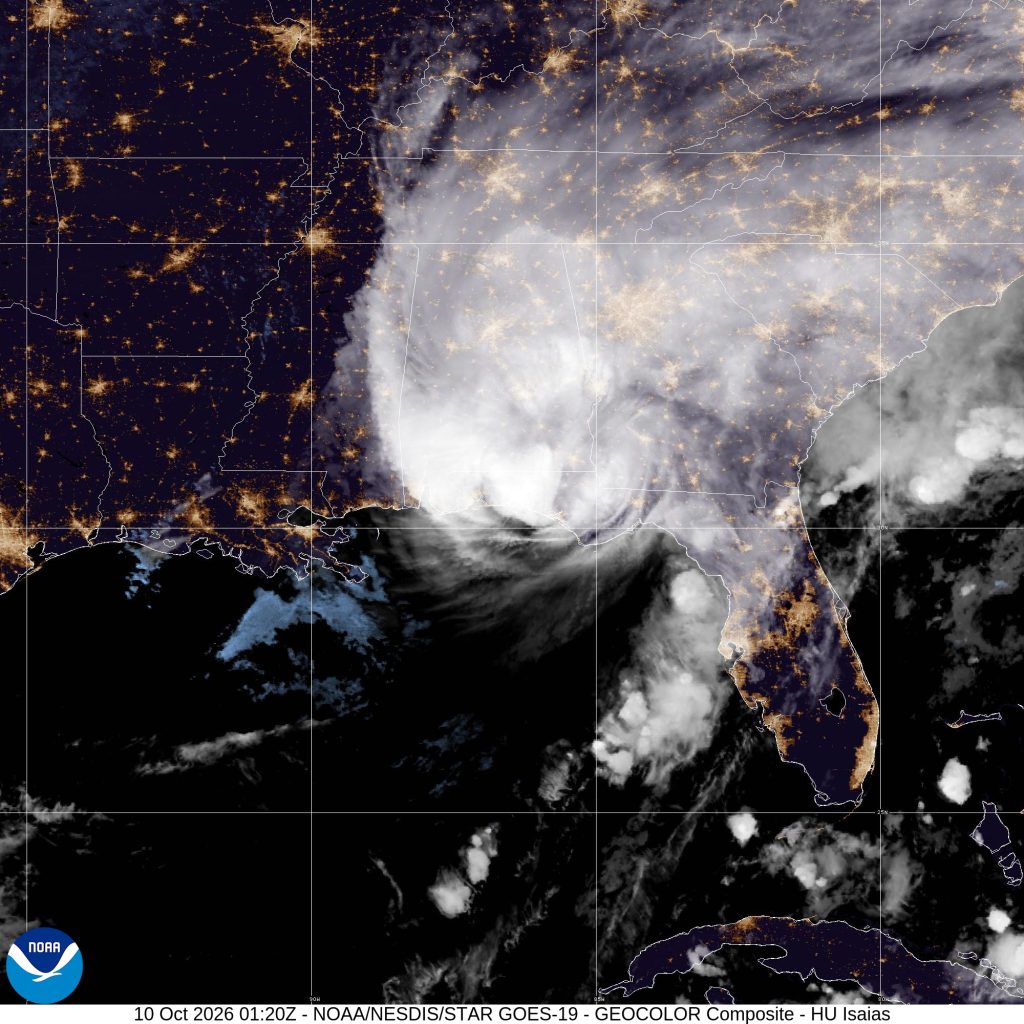
Hurricane Isaias struck Florida’s western Panhandle on Friday evening as a Category 2 storm, bringing destructive winds and dangerous coastal flooding to a region where a Moody’s analysis identified $71.8 billion in potentially wind-exposed commercial real estate.
The Associated Press reported landfall near Destin, with maximum sustained winds of 105 mph. The National Hurricane Center’s 7 p.m. Central advisory had placed Isaias about 45 miles southeast of Pensacola, moving north at 18 mph with sustained winds of 110 mph, and warned that landfall was imminent. Wind measurements and the storm’s position were changing rapidly as it moved ashore.
For property owners, lenders, insurers and servicers, the immediate concern is the extent of damage from wind, surge and rain across the northern Gulf Coast. Officials were still responding to the storm Friday night. Neither the commercial-property exposure figures nor early reports of widespread outages establish a final loss estimate.
What the $71.8 billion figure measures
Moody’s analysis, published October 8, identified 31,659 commercial properties in Alabama, Florida and Mississippi with a greater than 50% probability of encountering winds of at least 50 mph. Their estimated combined replacement value was $71.8 billion. Mobile, Alabama, and Pensacola, Florida, ranked among the markets with the largest concentrations of exposed commercial property.
The distinction between exposure and loss is crucial. Moody’s modeled the probability of damaging wind speeds using its RMS HWind data as of October 7. The estimate does not say that all 31,659 buildings were damaged, that $71.8 billion will be lost, or that the properties carry insurance covering their full replacement value. It excludes storm surge and flooding, which can produce severe losses even outside the strongest wind corridor. The company’s property database also does not include every building.
Moody’s storm-response updates describe an approximately 225-mile coastal stretch with substantial exposure. Commercial properties in the footprint include multifamily housing, offices, retail space, industrial buildings and other structures. Actual damage will depend on the storm’s track, local wind gusts, inundation, building construction and the condition of each property.
Separate reporting on the same risk estimates identified approximately $40.2 billion in potentially exposed multifamily property. That is part of the broader commercial exposure figure, not an additional $40.2 billion to add to the total. Investors and lenders with apartment collateral in coastal markets will need property-level inspections rather than extrapolating losses from a regional model.
Storm surge and flooding remain major threats
The National Hurricane Center warned of life-threatening storm surge along a broad stretch of coastline from the mouth of the Mississippi River to the Suwannee River in Florida. Its advisories also warned of heavy rain, flash flooding, damaging winds and possible tornadoes extending inland as Isaias moved toward Alabama and the Tennessee Valley.
Flood and surge exposure can be especially consequential for real estate financing because a property’s physical damage may be covered under different policies, exclusions, limits and deductibles. Whether a specific loan has adequate flood coverage cannot be determined from a regional hazard map. The same is true for business-interruption insurance on commercial properties and loss-of-rents protection on rental buildings.
For mortgage servicers, the operational response generally begins with identifying borrowers and collateral in declared disaster areas, confirming the availability of property insurance and assessing whether homeowners need assistance while repairs are underway. Agency and government-backed loans have distinct disaster-relief procedures. Borrowers should consult their servicers for loan-specific options rather than assume that every hurricane-affected loan automatically receives the same relief.
Insurers also face a rapidly evolving claims picture. WRE reported earlier Friday that Citizens Property Insurance had suspended certain new binding activity as the hurricane approached. The landfall is a separate development that will put the focus on claims, inspections, access to damaged properties and the timing of any resumption of normal insurance operations.
Early disruption is not a final damage assessment
As Isaias approached the coast, authorities ordered evacuations, closed schools and airports, and staged emergency personnel. The Associated Press reported that more than 365,000 utility customers had lost power as the storm affected Florida and Alabama. Those outage counts are a moving snapshot, not a count of damaged homes or buildings.
Commercial and residential property owners may face a prolonged period before damage is fully assessed. Floodwaters can delay inspections, and electrical outages can interrupt businesses even where structural damage is limited. In the coming days, local emergency managers, insurers, catastrophe-modeling firms and federal agencies are likely to produce more complete assessments. Their estimates may differ because they measure different things: replacement cost, economic disruption, insured losses or confirmed physical damage.
Friday’s landfall also marks an abrupt change in a quiet Atlantic hurricane season. Isaias was the season’s first hurricane and intensified sharply before reaching the northern Gulf Coast. For the housing and mortgage industries, however, the more immediate questions are local: which properties took on water, which buildings suffered wind damage, how quickly insurance adjusters can reach them, and whether borrowers can continue making payments while homes and businesses recover.
The $71.8 billion estimate provides a measure of the assets potentially in harm’s way. It should not be mistaken for the bill the storm will leave behind.