 Weekly Real Estate News


Summary
Mortgage lending became substantially safer after the financial crisis, but new data raises an uncomfortable question: Has the industry gone too far in eliminating risk? John G. Stevens examines the sharp decline in mortgages going to moderate-credit borrowers, changes to automated underwriting and credit scoring, and why expanding responsible access to mortgage credit does not require returning to the lending practices that preceded 2008.
There are some lessons the mortgage industry learned the hard way.
We learned what happens when loans are made without adequately documenting income. We learned what happens when borrowers are qualified into products they do not understand or cannot reasonably afford. We learned what happens when risk gets packaged, transferred and sold until everyone believes somebody else is responsible for it.
Nobody serious about housing finance should want to go back there.
But nearly two decades after the financial crisis, I think we need to be willing to ask a different question. Not whether mortgage lending should remain responsible. Of course it should.
The question is whether we have become so focused on preventing bad loans that we are also preventing some good borrowers from getting mortgages.
There is now data that makes that question difficult to ignore.
The Pew Charitable Trusts released an extensive analysis of mortgage lending standards this month. One number in the report jumped off the page at me.
In 2000, lenders originated approximately 1.08 million purchase mortgages to borrowers with credit scores between 601 and 660. Those borrowers represented 22.3% of purchase mortgage originations that year.
By 2024, borrowers in that same credit-score range received approximately 293,000 purchase mortgages.
Their share of purchase originations had fallen to 9.5%.
That is a 73% decline in the number of purchase mortgages made to this group.
Some of that difference could reasonably be explained if Americans simply had much better credit today and there were dramatically fewer consumers in the moderate-credit population. But the population data does not come close to explaining the change. Pew reports that from 2005 to 2024, the percentage of American adults with FICO scores between 600 and 699 declined only from 24.5% to 22.2%.
The borrowers did not disappear.
Their mortgages largely did.
The borrower entering today’s mortgage market looks very different
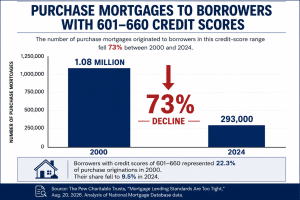
Purchase mortgages to borrowers with 601–660 credit scores declined 73% from 2000 to 2024
The average credit score of a new mortgage borrower reached 742 in 2024, according to Pew’s analysis. That was 29 points higher than the average score of consumers nationally.
Think about what that means.
We are not simply talking about eliminating the worst-performing loans that preceded the financial crisis. Today’s mortgage market increasingly serves consumers who arrive with very strong credit profiles.
There is nothing inherently wrong with that. Credit history matters. It should matter.
A mortgage is an enormous financial obligation, and lenders have an obligation to determine whether somebody is likely to repay it. Investors have a right to expect loans to be responsibly underwritten. Taxpayers should not be asked to absorb irresponsible risk.
And lower credit scores are associated with greater mortgage risk.
Pew’s analysis of Fannie Mae and Freddie Mac loan-performance data makes that clear. Among borrowers with scores of 619 or lower whose mortgages were purchased by the GSEs from 1999 through 2024, 12.7% experienced a delinquency of at least 180 days at some point and 6.5% eventually defaulted. Among borrowers in the 760-to-779 range, those figures were 1.3% and 0.4%, respectively.
Those numbers matter because any discussion about expanding mortgage access that ignores risk is not a serious discussion.
I am not suggesting we lower standards until more people qualify. I am certainly not suggesting that every household with a 620 credit score should receive a mortgage.
I am suggesting something much more basic.
A credit score is an indicator of risk. It is not the borrower.
We have gotten much better at measuring risk
There is another reason this conversation should be happening now.
The mortgage underwriting system of 2026 is not the mortgage underwriting system of 2006.
Fannie Mae made an important change last year that received far less attention outside the industry than it deserved. Beginning with new Desktop Underwriter loan casefiles created on or after November 16, 2025, Fannie Mae eliminated the previous minimum 620 credit-score requirement for loans evaluated through DU.
That does not mean Fannie Mae stopped evaluating credit risk. Quite the opposite.
Fannie Mae says DU performs a broader analysis of the borrower’s credit report and other risk factors rather than using a minimum score as an automatic eligibility threshold.
Freddie Mac takes a similar approach with mortgages receiving an “Accept” determination through Loan Product Advisor. Its current guide says a minimum Indicator Score is not required for those loans because LPA evaluates whether the borrower’s credit reputation and the mortgage product are acceptable.
That is progress.
It is also an acknowledgement of something our industry has known for a long time: a borrower cannot always be understood through one three-digit number.
Someone can have a moderate credit score because of persistent financial problems. Someone else can have one because of a limited credit history. Another borrower may have gone through a temporary hardship several years earlier but has since established stable employment, accumulated savings and consistently paid rent.
Those are not necessarily the same risks.
Our underwriting systems should be capable of recognizing the difference.
This is not an argument for another subprime era
Whenever this subject comes up, 2008 enters the conversation almost immediately. It should.
There is a reason underwriting tightened after the financial crisis.
There were loans that should never have been made. There were products that allowed risk to accumulate in ways borrowers, lenders, investors and regulators did not adequately understand. The consequences were catastrophic.
But I worry that we have allowed the memory of that period to create a false choice.
We do not have to choose between extremely restrictive mortgage credit and irresponsible lending.
There is an enormous amount of territory between those two things.
Consider FHA. Federal policy has long recognized that credit score and down payment can be evaluated together rather than treating credit score as an absolute measure of mortgage readiness. FHA policy established that borrowers with scores of 580 or higher could qualify for the minimum 3.5% down payment, while borrowers between 500 and 579 would generally need at least 10% down.
The underlying principle is important even beyond FHA: risk factors can be considered together.
Credit history matters.
So does equity.
So does income.
So does employment.
So do reserves.
So does debt.
So does the actual payment a borrower will be required to make every month.
The purpose of underwriting should be to determine whether the total borrower and loan represent an acceptable risk. It should not be to find one imperfect characteristic and stop looking.
The people affected by this are exactly who you would expect
The consequences of a credit system that heavily favors pristine credit profiles are not evenly distributed.
Using National Survey of Mortgage Originations data from 2013 through 2023, Pew found that about 19.5% of mortgage borrowers overall had credit scores between 600 and 699.
Among first-time buyers, the figure was 26.8%.
Among rural borrowers, 25.3%.
Among borrowers under age 25, 33.5%.
Among Black mortgage borrowers, 37.5%.
These statistics do not tell us that every borrower in those groups should have qualified for a different mortgage. They certainly do not tell us that underwriting standards are discriminatory simply because outcomes differ.
They tell us something narrower and important: when access to mortgage credit becomes increasingly concentrated among consumers with excellent credit, the effects will fall disproportionately on groups that are more likely to have moderate or limited credit histories.
That deserves attention in a country that spends an enormous amount of time talking about the difficulty of becoming a first-time homeowner.
There is another number we cannot ignore
The mortgage market we have created is performing extraordinarily well by historical standards.
Pew found that mortgage delinquency rates have remained relatively low for more than a decade and are currently near 25-year lows. It also reports that default rates are at the lowest level in the available historical data, aided not only by tighter underwriting but by more effective loss-mitigation options for borrowers who fall behind.
That is good news.
We should want a mortgage system that performs well.
But there is a point at which exceptionally low losses should cause policymakers and the industry to ask whether we have found the optimal level of risk or simply the minimum level of risk.
Those are not the same thing.
A mortgage market could theoretically drive defaults even lower by lending only to borrowers with enormous down payments, exceptional incomes and 800 credit scores.
It would be incredibly safe.
It would also be a terrible housing-finance system.
The objective cannot be zero risk. Lending involves risk. The objective should be identifying, pricing and managing reasonable risk without exposing borrowers or the financial system to reckless lending.
This is where the next mortgage innovation should happen
The industry has spent years talking about innovation.
We have made applications faster. We have automated document collection. We can verify income and assets digitally. We have improved fraud detection. Automated underwriting systems can evaluate enormous amounts of borrower information almost instantaneously.
Those improvements are useful.
But the most meaningful innovation may be using all of that technology to determine more accurately who can actually repay a mortgage.
FHFA is already moving in that direction. In 2026 it continued the transition toward allowing newer credit-score models in the GSE mortgage system, including an interim framework under which approved lenders may deliver mortgages using either Classic FICO or VantageScore 4.0.
That modernization matters. But changing the score alone will not solve the larger problem.
We should be examining whether rental-payment history, cash-flow information, reserves, residual income and other demonstrated financial behaviors can responsibly supplement traditional credit information. We should continue improving automated underwriting so that compensating factors actually compensate. We should examine whether risk-based pricing appropriately distinguishes between borrowers or sometimes makes an otherwise sustainable mortgage economically impossible.
And we should measure the results.
If expanding access produces unacceptable delinquency and default, adjust.
If certain underwriting changes allow additional borrowers to become successful homeowners without materially increasing losses, expand them.
That is what risk management is supposed to be.
We already solved the last crisis
The mortgage industry should be proud of some of what changed after the financial crisis.
Documentation improved. Underwriting improved. Loan quality improved. Servicing and loss mitigation improved. The market is substantially different from the one that entered the financial crisis.
We should protect those gains.
But housing policy cannot remain permanently frozen around preventing the last disaster.
There are families today who earn good incomes, pay their rent every month, have money in the bank and are prepared for the responsibilities of homeownership, but do not fit neatly inside the credit profile our mortgage system has come to prefer.
Some of those people should not receive a mortgage yet.
Some of them probably should.
Our job should be figuring out the difference.
If, after twenty years of better data, better technology, automated underwriting and dramatically improved loan performance, the safest answer we can give a borrower with an imperfect credit history is still simply “no,” then I am not sure we have perfected mortgage underwriting.
We may have simply perfected avoiding risk.




The next challenge is high closing costs in many states – as those with budget issues have increased transfer and recordation taxes. This is what impedes buyers in our east coast states.