Weekly Real Estate News

Summary
MBA reports September 2026 new-home mortgage applications fell 8.3% year over year and estimated sales reached their lowest annualized pace since April 2020.
Mortgage applications to buy newly built homes fell 8.3% from a year earlier in September, and the Mortgage Bankers Association estimated new-home sales dropped to their slowest annualized pace since April 2020 as higher borrowing costs chilled demand.
The MBA’s October 15 Builder Application Survey showed an 8% decline in purchase applications from August. Those application comparisons are not adjusted for normal seasonal patterns. The association’s separate estimate of new single-family home sales, which is seasonally adjusted, fell 12% from August to an annual rate of 584,000.
The decline is a warning for builders entering the final quarter of the year. It also suggests that mortgage-rate increases in September weighed on a part of the housing market that has relied heavily on builder incentives and rate buydowns to keep transactions moving.






“The increase in mortgage rates in September had a chilling effect for new home purchase activity,” said Joel Kan, MBA’s vice president and deputy chief economist, in the release. He added that the decline in the FHA share of applications and the increase in average loan size indicated that higher rates were affecting first-time buyers’ decisions.
MBA estimated that builders sold 47,000 new single-family homes in September on an unadjusted basis, down 9.6% from 52,000 in August. The seasonally adjusted 584,000 annual pace compares with 664,000 in August. The annualized number should not be confused with the number of houses actually sold during September.
FHA share slips as average loan amount rises
Conventional financing accounted for 50.2% of new-home purchase applications in September, according to the survey. FHA loans represented 34.7%, VA loans 14.1% and USDA’s Rural Housing Service 1.0%.
The average requested loan amount increased to $374,724 from $373,194 in August. That change is modest in dollar terms, but alongside a smaller FHA share it adds to concerns about the ability of more payment-sensitive households to purchase newly built homes.
Those figures do not establish that prices for comparable new homes rose. Average loan size can shift with the geographic mix of applications, the types of homes being purchased and the down payments borrowers use. Nor can the loan-type shares alone determine precisely how many first-time buyers withdrew from the market.
The Builder Application Survey collects application data from mortgage subsidiaries of homebuilders. MBA combines that information with assumptions about market coverage and other inputs to produce an early estimate of sales. The official new-home sales report comes from the Census Bureau and may differ from MBA’s model.
That distinction matters especially when a report produces an unusually weak reading. MBA’s comparison with April 2020 refers to its own estimated sales series. The Census Bureau’s forthcoming September figures will offer a separate measure of the market and may not match the survey’s implied monthly decline.
Builders face a tougher fourth quarter
Higher mortgage rates directly raise the monthly payment on a new-home purchase unless the builder absorbs part of the cost through financing incentives or adjusts the price. That tradeoff can pressure builder margins even when incentives keep a contract from falling through.
The new figures extend the weakness seen in MBA’s August survey, when WRE News reported that new-home mortgage demand was already losing momentum. September’s report now shows a sharper month-to-month deterioration and the lowest estimated annualized sales pace since the early pandemic.
For mortgage lenders, builder-affiliated originators and developers, the next questions are whether applications recover as rate conditions change and how much demand builders can sustain with incentives. The September reading is one month of survey evidence, not proof that a prolonged collapse in new-home sales is inevitable.
For now, the survey’s clearest message is that September’s borrowing-cost increase was followed by fewer applications and a materially weaker estimate of sales. The official Census sales release and builders’ upcoming operating results will help show whether that slowdown persisted into October.
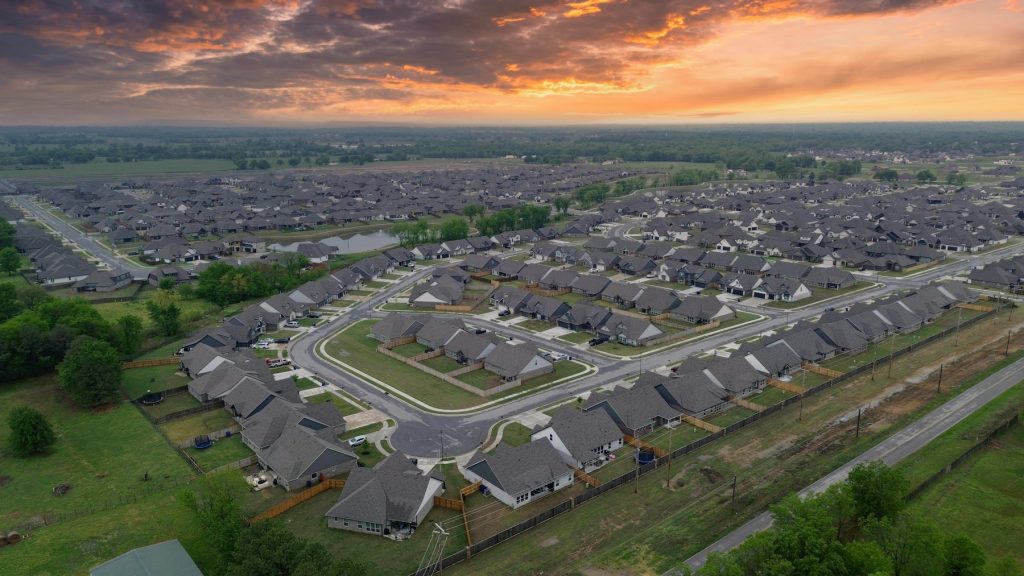
Featured image: Newly developed homes in Oklahoma, photographed by Tyler Fulk/Unsplash. Illustrative photograph; not a development identified in the MBA survey.