 Weekly Real Estate News
Summary
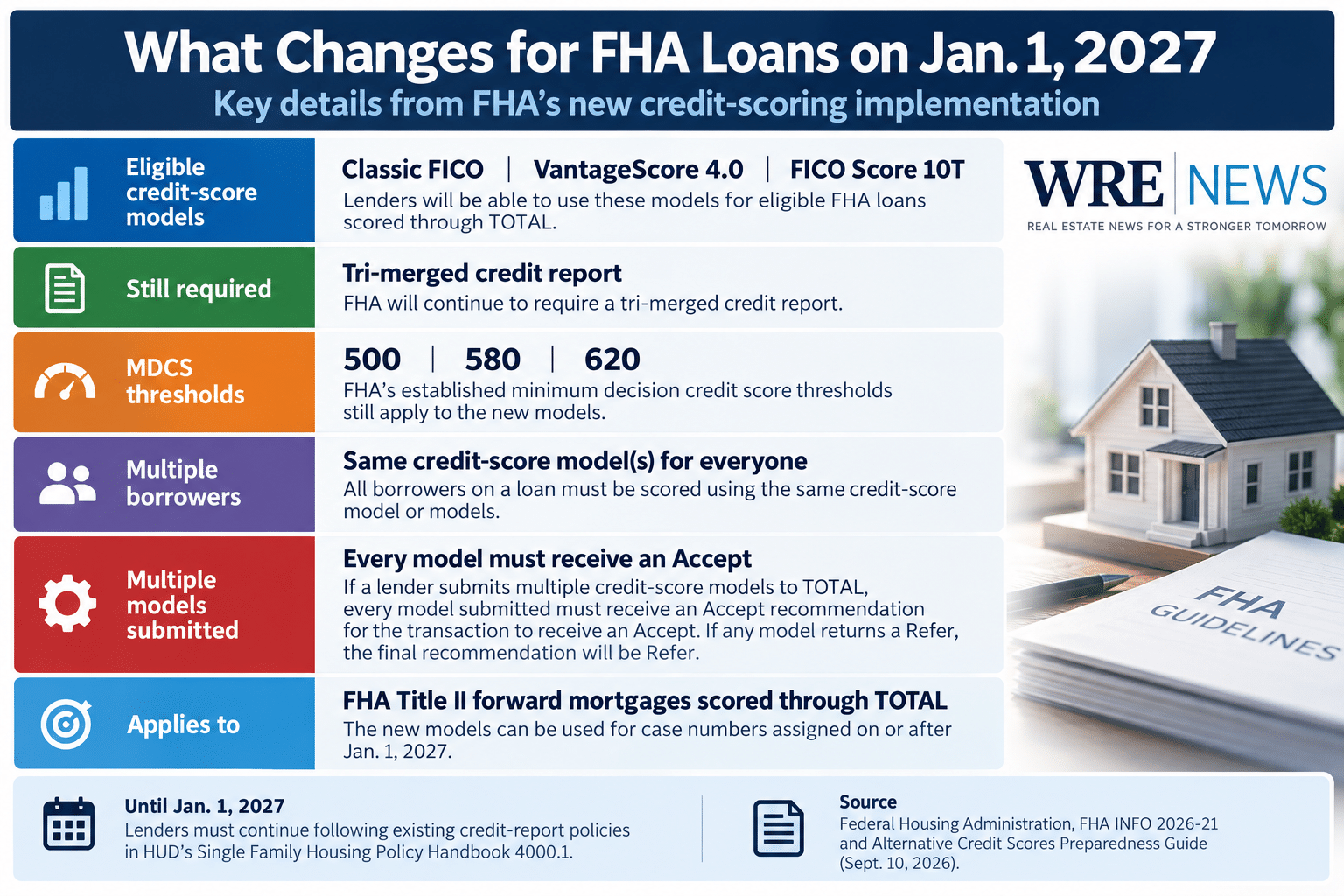
The Federal Housing Administration will begin accepting VantageScore 4.0 and FICO Score 10T alongside Classic FICO for eligible Title II forward mortgages scored through FHA's TOTAL Mortgage Scorecard beginning with case numbers assigned Jan. 1, 2027 or later. FHA's tri-merge credit-report requirement and established MDCS thresholds of 500, 580 and 620 remain in place. FHA also says all borrowers on a loan must use the same scoring model or models, and when multiple models are submitted, every model must return an Accept recommendation for the transaction to receive an Accept.
The agency has finally put a date on one of the biggest changes to FHA mortgage credit scoring in decades. Beginning Jan. 1, lenders will be able to use VantageScore 4.0 and FICO Score 10T alongside Classic FICO for eligible FHA loans, but the implementation rules contain some important details.
The Federal Housing Administration has given mortgage lenders a deadline for preparing for its new credit-scoring framework.
Beginning with FHA case numbers assigned on or after Jan. 1, 2027, lenders will be able to use VantageScore 4.0 and FICO Score 10T in addition to Classic FICO when submitting eligible mortgages through FHA’s TOTAL Mortgage Scorecard.






The implementation date, announced by FHA on Sept. 10, turns a policy initiative announced earlier this year into an operational change lenders now have less than four months to prepare for.
FHA also released an Alternative Credit Scores Preparedness Guide spelling out how the new scores will interact with its underwriting system.
For lenders, credit providers and mortgage technology companies, some of the most important news is what FHA isn’tchanging.
The agency will continue to require a tri-merged credit report. Its established minimum decision credit score thresholds of 500, 580 and 620 will also apply to the new scoring models, according to FHA.
The change is about which credit-score models can be used within the existing FHA framework, not an abandonment of FHA’s current credit standards.
That distinction is important as the mortgage industry moves toward a credit-scoring system that, after decades of dependence on Classic FICO, is beginning to offer lenders competing models.
FHA’s January rollout has a narrower scope than the headline suggests
The Jan. 1 implementation applies specifically to FHA Title II forward mortgage programs scored through the TOTAL Mortgage Scorecard.
FHA said TOTAL will be updated for case numbers assigned on or after that date so the system can accept the additional scoring models.
Until the new guidance is formally published and the Jan. 1 implementation takes effect, mortgagees are supposed to continue following existing credit-report policies in HUD’s Single Family Housing Policy Handbook 4000.1.
There is another operational detail lenders will need to understand.
All borrowers on a loan must be scored using the same credit-score model or models.
A lender, for example, cannot submit VantageScore 4.0 for the primary borrower and FICO Score 10T for a co-borrower.
And using multiple scoring models does not necessarily give the lender multiple chances at an approval.
It can do the opposite.
If a lender submits multiple credit-score models to FHA’s TOTAL Scorecard, every model submitted must receive an Accept recommendation for the transaction to receive an Accept.
FHA’s guide says that if any one of the submitted models returns a Refer recommendation, the final recommendation will be Refer.
The agency says lenders may work with their credit providers to remove one or more models and resubmit the loan if desired. FHA also notes that lenders may prefer to submit a single credit-score model for all borrowers.
That is a technical detail, but it could become an important workflow decision for lenders once the system goes live.
FHA isn’t changing the familiar 500 and 580 thresholds
One question lenders and loan officers are likely to hear is whether newer scoring models mean FHA is changing its basic credit-score thresholds.
According to the preparedness guide, it isn’t.
FHA says its established minimum decision credit score thresholds of 500, 580 and 620 apply to the new models.
The process for determining the Minimum Decision Credit Score, or MDCS, also remains familiar when a lender submits a single model.
If three different scores are reported, the middle score is used. If two differing scores are reported, the lower score is used. If only one score is reported, that score becomes the MDCS.
For loans with multiple borrowers, the transaction uses the lowest borrower MDCS.
The calculation gets another step when multiple scoring models are submitted. FHA says an MDCS must first be determined for each borrower under each scoring model, and the borrower’s MDCS is then based on the lowest of the model scores. The transaction ultimately uses the lowest MDCS among all borrowers.
That means lenders adding multiple models will need systems capable not simply of obtaining the new scores, but of handling FHA’s rules for evaluating them.
The mortgage industry’s credit-score transition is accelerating
FHA’s implementation date arrives during a much broader change in mortgage credit scoring.
WRE News reported in April that HUD and the Federal Housing Finance Agency were moving to add VantageScore 4.0 and FICO Score 10T to the mortgage system.
At the time, FHA confirmed its intention to permit the two newer models alongside Classic FICO but had not yet announced when lenders would actually begin using them.
Now it has.
The government-sponsored enterprise side of the market has also moved quickly.
On Sept. 9, Fannie Mae announced that VantageScore 4.0 was being expanded to all Fannie Mae-approved lenders.
Freddie Mac made the same move, saying all sellers may now use VantageScore 4.0 when originating and selling eligible mortgages to the GSEs without obtaining prior written approval.
Classic FICO remains an approved option for the GSEs, while implementation of FICO Score 10T is still to come.
The result is that a mortgage industry accustomed to working around a single dominant credit-score model is entering a period in which lenders may increasingly have choices about which model they use.
That creates competition, but it also creates operational complexity.
This is now a technology project, not just a policy story
For mortgage executives, the Jan. 1 date means the credit-score transition has moved out of the policy-discussion stage.
FHA is specifically telling mortgagees to contact their credit and technology partners to make sure systems, processes and capabilities are ready for implementation.
The agency has released TOTAL Developer’s Guide Release 5.0 for automated underwriting system vendors, with software mapping and technical specifications needed to integrate the new version of TOTAL.
FHA’s Resource Center knowledge base is scheduled to be updated when TOTAL Version 5.0 is released Jan. 1.
The agency is also planning virtual office hours for mortgagees and other stakeholders during the week of Nov. 16 and again during the week of Jan. 11, after implementation.
That gives lenders a relatively short runway.
Credit providers have to make the appropriate models available. Technology vendors have to support them. Lenders have to decide which models they intend to use and how they will handle loans involving multiple borrowers or multiple scoring models. Operational and underwriting teams need to understand how those choices affect TOTAL recommendations.
Loan officers will eventually need to understand the differences well enough to explain them without suggesting that one model guarantees a better underwriting result.
New scores don’t guarantee new approvals
The policy has been promoted partly as a way to introduce competition into mortgage credit scoring and potentially expand access to borrowers whose financial behavior may not be captured as effectively by older models.
HUD Secretary Scott Turner said when the initiative was announced in April that adding newer models was intended to expand access to homeownership, particularly for creditworthy borrowers who may have been overlooked by older systems.
But the January implementation should not be interpreted as a blanket loosening of FHA underwriting.
The existing credit-report requirement remains. FHA’s MDCS thresholds remain. TOTAL still evaluates the transaction. And if a lender chooses to submit multiple credit-score models, all of them have to clear the scorecard for the loan to receive an Accept recommendation.
The potential impact will depend in part on how lenders use the choices FHA is giving them and how differently borrowers score under the competing models.
That makes the next phase more consequential than the announcement itself.
The mortgage industry has spent years debating whether competition in credit scoring could lower costs, improve risk assessment or allow more creditworthy borrowers into the mortgage market.
Beginning Jan. 1, FHA lenders will start getting the opportunity to find out.